
Views: 0 Author: Site Editor Publish Time: 2026-07-14 Origin: Site


Integrating essential electrical hardware into residential and commercial spaces without compromising aesthetics remains a persistent architectural challenge. The market is flooded with cheap, plastic decorative strips that mimic wood but lack fundamental thermal and electrical safeguards. These substandard devices present significant fire and equipment damage risks when placed under heavy loads. To safely bridge the gap between design and function, buyers must evaluate these devices through a strict technical lens. You cannot rely on visual appeal alone when dealing with live electrical currents. This guide breaks down the engineering, compliance standards, and safety mechanisms required in a reliable wood grain power strip. We will examine the exact specifications that separate a dangerous novelty item from a structurally sound power delivery system.
Material Integrity is Non-Negotiable: A true wood grain aluminum PDU power strip with circuit breaker capabilities offers superior heat dissipation and fire resistance compared to hydro-dipped plastic alternatives.
Certification Dictates Reliability: Legitimate US standard power solutions must carry independent laboratory testing marks (UL, ETL, or CSA) verifying their safety under maximum load conditions.
Surge vs. Overload Protection: Understanding the technical distinction between joule ratings (surge) and amperage limits (overload) is critical for preventing catastrophic hardware failure.
Application Limits: Even high-end residential PDU solutions have strict load thresholds; matching the power distribution unit to the specific environmental and hardware draw is essential for safe deployment.
A successful decorative power distribution unit must seamlessly blend into architectural environments. It should complement hardwood floors, custom cabinetry, and high-end office furniture. However, it must also maintain the complete safety profile of an industrial-grade device. Achieving this balance requires strict adherence to electrical engineering principles. You cannot sacrifice thermal management for a sleek profile. When designers push for smaller, less obtrusive hardware, engineers must compensate with better materials and smarter internal layouts.
Many low-tier decorative strips prioritize form over function. Manufacturers often take dangerous engineering shortcuts to keep production costs low. You will frequently find thin-gauge wiring, absent internal grounding, and substandard soldering on the internal bus bars. Furthermore, these units often use highly flammable outer coatings. These coatings mimic wood but ignite rapidly under electrical stress. A hydro-dipped plastic shell might look like oak, but it melts like wax when a loose connection arcs.
Concealing electrical hardware introduces severe thermal dynamic risks. Heat generation becomes a major issue when you place a power strip flush against wood furniture. The risk multiplies when mounting units in enclosed spaces or tucking them under rugs. Superior thermal management is an absolute baseline requirement for any hidden electrical device. Without proper airflow, the internal temperature of a poorly designed unit will steadily climb until the insulation degrades and a short circuit occurs.
To understand the physical differences, consider the following structural comparisons between high-end and low-end units:
High-end units use solid copper bus bars for power distribution.
Low-end units rely on thin, daisy-chained wires with weak solder joints.
Premium models feature isolated grounding paths for each receptacle.
Budget models often share a single, flimsy ground wire across all outlets.
Quality devices utilize high-impact, fire-retardant internal brackets.
The structural foundation dictates the safety of the device. A genuine wood grain aluminum PDU power strip with circuit breaker utilizes an extruded aluminum housing. Aluminum offers exceptional thermal conductivity, drawing heat away from internal components. In contrast, ABS or polycarbonate plastics trap heat and warp under sustained thermal loads. When you run multiple devices simultaneously, the internal resistance generates heat. Aluminum acts as a passive heatsink, dispersing this thermal energy safely into the surrounding air.
The finish application method also impacts safety. Sublimated dye or powder-coated wood grain finishes on aluminum maintain chemical and thermal stability. The wood pattern is baked directly into the metal surface. Conversely, cheap PVC or vinyl wraps act as thermal insulators. They trap heat and present a severe flammability risk during an overload event. If the internal wiring overheats, a vinyl wrap will melt, release toxic fumes, and potentially catch fire.
Feature | Extruded Aluminum Housing | Plastic/PVC Housing |
|---|---|---|
Thermal Conductivity | Excellent (Dissipates heat rapidly) | Poor (Traps heat internally) |
Fire Resistance | Non-combustible base material | Highly flammable (unless heavily treated) |
Structural Integrity | Rigid, resists crushing and impact | Brittle, prone to cracking under weight |
Finish Stability | Powder-coated/sublimated (Heat stable) | Vinyl wrapped (Melts and peels) |
Grounding Capability | Chassis can be grounded for safety | Cannot ground a plastic chassis |
An integrated circuit breaker is a mandatory safety feature. Typically rated for 15A or 20A, this component prevents catastrophic wire failure. The mechanical trip response relies on a bi-metallic strip. When the continuous electrical draw exceeds the rated capacity, the strip heats up and bends. This action physically severs the circuit, instantly stopping current flow and preventing wire insulation from melting. You must ensure the breaker matches the rating of the internal wiring and the wall receptacle.
Joule ratings define the energy absorption capacity of the unit. Standard electronics require moderate protection, while high-value workstations demand high joule ratings. However, joules only tell part of the story. Clamping voltage, or let-through voltage, indicates how much excess power reaches your devices before the surge protector reacts. Lower clamping voltages offer better protection. Response time, measured in nanoseconds, dictates how quickly the unit reacts to a voltage spike. A fast response time is non-negotiable for protecting sensitive microprocessors.
Diagnostic LEDs provide critical system health information. A "Protected" indicator confirms the Metal Oxide Varistors (MOVs) are actively functioning. A "Grounded" indicator detects dangerous outlet wiring faults. This is especially vital in older residential walls where ground wires may be compromised or missing. If the grounded light fails to illuminate, you must consult an electrician before using the outlet.
Heavy-duty copper wiring minimizes electrical resistance. High-quality units utilize 14 AWG or 12 AWG internal wiring to reduce heat generation. Fire-retardant internal mounting brackets and isolated grounding paths further enhance the safety profile. Integrated smart USB ports require specific engineering safeguards. Manufacturers must include isolated step-down transformer circuits. These circuits prevent high-voltage alternating current (AC) from bleeding into the low-voltage direct current (DC) charging ports, protecting your connected mobile devices.
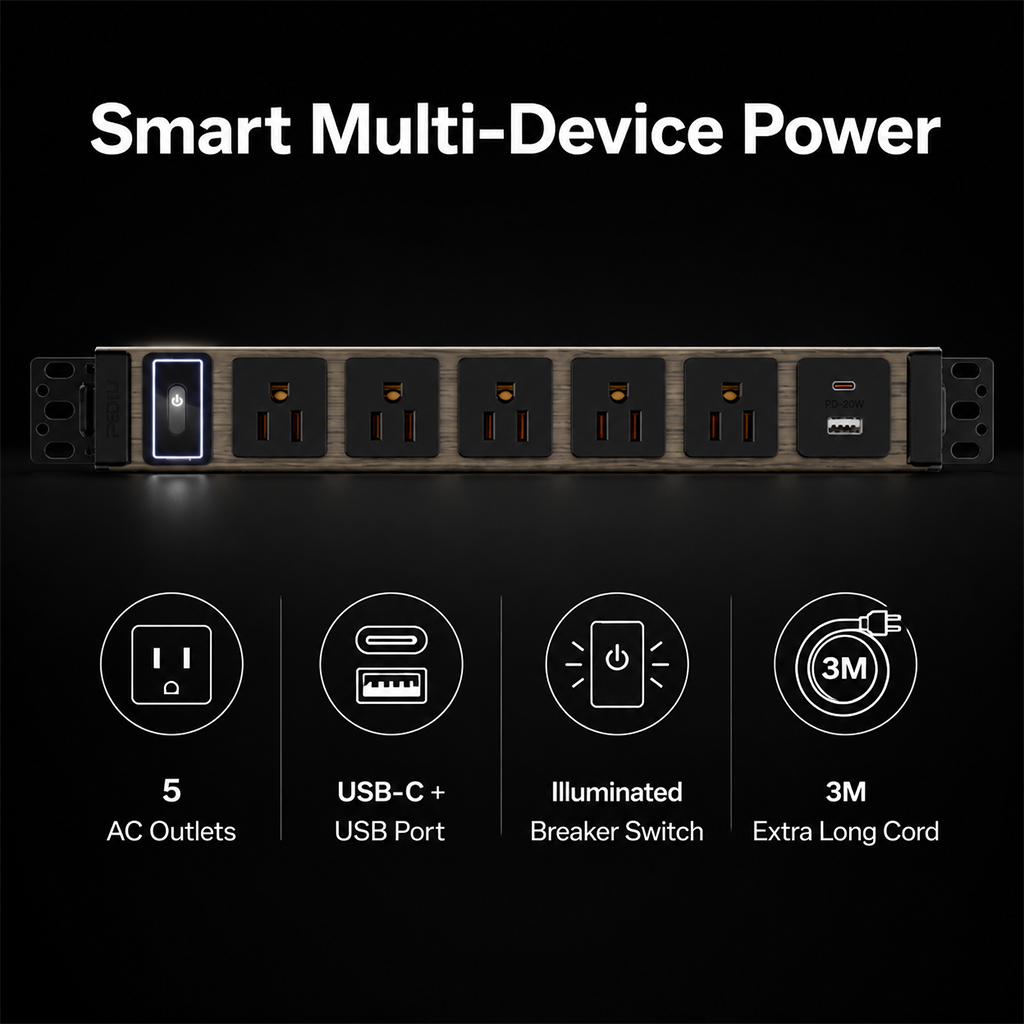
Legitimate US standard power solutions undergo rigorous independent testing. UL 1363 covers Relocatable Power Taps, establishing baseline safety for standard strips. UL 1449 applies specifically to Surge Protective Devices. UL 62368-1 evaluates equipment handling audio, video, and communication technology. Always verify ETL or UL listing numbers via online public directories. Counterfeit certification marks are common on imported decorative electronics. A fake UL sticker offers zero protection when a power surge hits your home theater.
Receptacle specifications must match your hardware requirements. NEMA 5-15R receptacles handle standard 15-amp loads, while 5-20R receptacles accommodate 20-amp equipment. Tamper-Resistant (TR) shutters offer critical safety benefits. Mandated by NEC 406.12 for certain applications, these shutters prevent the accidental insertion of foreign objects. This feature is particularly important in residential settings with small children.
Firm receptacle retention is vital for fire prevention. High grip strength prevents arcing caused by loose plug connections. When a plug sits loosely in an outlet, the electrical current can jump the gap, creating intense heat and sparks. Additionally, low-profile, 45-degree angled flat plugs provide mechanical utility. They avoid cord pinching and prevent wall receptacle shear when positioned behind heavy furniture. A standard straight plug can easily be crushed by a bookshelf, exposing live wires.
The external power cord must withstand environmental stress. Heavy-duty cord jackets, carrying SJT or SJTW ratings, resist physical abrasion and moisture. The mechanical strain relief boot requires equal attention. This junction, where the cord enters the chassis, prevents internal copper wire fraying. A robust strain relief boot stops short circuits caused by repeated cord flexing. If you can bend the cord sharply at the chassis entry point without resistance, the strain relief is inadequate.
Check the UL or ETL directory for the specific model number.
Verify the NEMA receptacle type matches your intended load.
Test the grip strength of the outlets with a standard plug.
Inspect the strain relief boot for rigidity and proper molding.
Confirm the cord jacket carries an appropriate SJT or SJTW rating.
Safe deployment requires accurate load calculation. Multiply Amps by Volts to determine total Watts. Ensure connected devices never exceed the 1800W or 2400W limits typical of residential PDU solutions. Never connect high-draw appliances to these units. Space heaters, laser printers, and hair dryers draw massive continuous current and will melt standard components. These devices must plug directly into a dedicated wall receptacle.
Daisy-chaining multiple strips violates OSHA and NEC fire codes. This practice compounds electrical resistance and bypasses intended safety limits. Secure mounting is equally important. Integrated aluminum mounting tabs provide superior stability compared to fragile plastic keyhole slots. If a unit falls while fully loaded with heavy power adapters, the physical shock can dislodge internal wiring and create a short circuit.
Mounting orientation directly impacts safety. Avoid face-up vertical orientations under desks. Liquid spills or conductive debris can easily fall into open receptacles, causing immediate shorts. Establish strict ventilation guidelines. Maintain minimum clearance requirements for heat dissipation when mounting units under desks or behind media consoles. Do not bury these devices under piles of cables or carpet.
Surge protection components degrade over time. Metal Oxide Varistors (MOVs) absorb finite amounts of energy. They function as consumables and will eventually fail after suppressing multiple surges. Conduct regular physical inspections. Look for discolored casing, feel for warm-to-the-touch surfaces, and listen for buzzing sounds. Any of these signs indicate immediate replacement is necessary. Do not ignore a buzzing sound; it often indicates arcing across a failing component.
The price delta between standard plastic strips and aluminum wood grain models reflects the engineering quality. Frame this upfront investment as equipment insurance. The cost of a premium unit is negligible compared to the replacement cost of a fried home theater system or a damaged professional workstation. You are paying for the extruded aluminum, the heavy-gauge copper, and the verified safety certifications.
Evaluate the fine print of Connected Equipment Warranties carefully. Manufacturers often include strict exclusions, complex claim limits, and specific coverage durations. The burden of proof required to claim damages is notoriously high. You usually have to ship the damaged unit back for inspection at your own expense. Preventing hardware failure via a high-quality, certified unit is vastly preferable to relying on a complex warranty claim process.
When assessing value, consider the lifespan of the device. A well-built aluminum unit will outlast several cheap plastic alternatives. The robust housing resists physical damage, and the high-quality internal components handle daily electrical stress without degrading prematurely. You save money in the long run by avoiding frequent replacements and protecting your expensive electronics from catastrophic failure.
Audit the intended power load of your space by calculating the total wattage of all devices you plan to connect.
Measure the required cord length precisely to ensure you reach the wall outlet without relying on dangerous extension cords.
Verify the grounding status of your wall outlet using a simple receptacle tester prior to plugging in any new equipment.
Check the public UL or ETL online directories to confirm the certification number stamped on the device chassis is legitimate.
A: Cheap plastic models with vinyl wraps trap heat and are highly flammable. However, fire-retardant aluminum models with sublimated finishes safely dissipate heat and do not pose a fire hazard when used within their rated limits.
A: A standard strip simply provides extra outlets. A PDU offers advanced load management, industrial-grade build quality, and superior internal components. PDUs are designed for continuous, heavy-duty applications rather than basic residential use.
A: No. Space heaters draw continuous high amperage that exceeds the safe operating limits of standard residential units. NEC guidelines mandate plugging high-draw thermal appliances directly into a dedicated wall receptacle.
A: Look for a holographic sticker or a stamped certification number directly on the chassis. You can then enter this specific control number into the UL Product iQ online directory to verify its authenticity.
A: Thick vinyl plastic wraps act as insulators and dangerously trap heat. Conversely, sublimated or powder-coated finishes applied directly to an aluminum chassis maintain excellent thermal conductivity and allow heat to escape safely.
A: AWG stands for American Wire Gauge. A lower number indicates a thicker copper wire. A 14 AWG cord is thicker than a 16 AWG cord, allowing it to safely handle higher electrical currents with less resistance and heat.
A: A grounded indicator confirms that the wall outlet has a proper path to earth ground. Without a functional ground, surge protection components cannot safely divert excess voltage, leaving your connected devices vulnerable to damage.


