
Views: 0 Author: Site Editor Publish Time: 2026-07-07 Origin: Site


Relying on consumer-grade power delivery for high-value equipment creates massive operational risk. Server racks, audio-visual setups, and advanced home labs require continuous, reliable power. We often face a tension between upfront savings and hidden risks. Equipment damage, unexpected downtime, and severe fire hazards frequently result from inadequate power distribution. Evaluating your power requirements objectively is absolutely necessary. This guide breaks down exactly when you should use a standard power strip versus upgrading to a dedicated PDU.
Core Functionality: Power strips are designed for basic, low-draw consumer electronics; a PDU (Power Distribution Unit) is engineered for continuous, high-load industrial or IT environments.
Build & Safety: PDUs feature heavy-duty construction (e.g., aluminum housing), strict compliance certifications, and integrated circuit breakers to prevent catastrophic overloads.
Advanced Capabilities: Unlike basic strips, enterprise and advanced residential PDU solutions offer features like remote monitoring, individual outlet switching, and load balancing.
Decision Matrix: The choice hinges on total amperage draw, mounting requirements (rack-mount vs. floor), and the financial impact of potential equipment downtime.
A standard consumer power strip serves a very specific, limited purpose. The internal architecture typically consists of a lightweight plastic housing. Inside, you will find basic thin-gauge internal wiring connecting standard NEMA 5-15R receptacles. These components handle intermittent loads well but fail under continuous stress. When you plug in a desktop computer, a monitor, and a desk lamp, the total amperage draw remains well below the physical limits of the internal copper wiring. The plastic casing provides adequate insulation for these low-heat applications.
Safety certification standards clearly define these limitations. Most consumer strips carry UL 1363 compliance. This standard covers relocatable power taps. It explicitly limits these devices to temporary, non-continuous applications. You should never deploy them as permanent infrastructure solutions inside a server rack or a professional audio-visual cabinet. The testing parameters for UL 1363 do not account for the sustained thermal loads generated by enterprise networking gear or heavy-duty amplifiers running 24/7.
These devices do have valid success criteria. They work perfectly for desktops, desk lamps, and basic home entertainment systems. Low-cost, multi-outlet expansion is the only requirement in these scenarios. They provide simple convenience without complex engineering. You can easily tuck them behind a sofa or under a desk to power a few low-wattage chargers and peripherals.
However, inherent limitations become obvious under continuous load. Internal busbars suffer from thermal degradation when pushed to their limits. They lack true power conditioning capabilities. Their amperage thresholds remain strictly limited, often leading to melted casings or tripped breakers when overloaded. If you attempt to run multiple high-draw servers off a single plastic strip, the internal resistance generates excess heat. Over time, this heat degrades the plastic housing, creating a severe fire hazard that threatens the entire facility.
A power distribution unit is a specialized device. Engineers design it to distribute electrical power reliably to multiple pieces of equipment. You typically find them mounted within a server rack or specialized enclosure. They handle continuous, heavy loads without thermal degradation. The internal architecture utilizes thick, heavy-gauge copper busbars designed to carry maximum amperage without generating dangerous levels of electrical resistance or heat.
Safety certifications separate them entirely from consumer devices. They carry UL 62368-1 and UL 60950-1 certifications. These standards authorize continuous, heavy-duty deployment in IT infrastructure environments. They guarantee the unit can survive demanding operational conditions. Testing for these certifications involves sustained load testing, thermal impact assessments, and rigorous fault-tolerance checks that consumer devices simply cannot pass.
Industrial-grade components define their construction. They utilize heavy-gauge internal copper busbars for superior conductivity. Robust metal enclosures protect the internal components from physical damage. High-retention outlets prevent accidental disconnects caused by vibration or cable tension. When you plug a server into a professional unit, the receptacle grips the plug firmly, ensuring that accidental bumps during rack maintenance do not result in catastrophic power loss to critical hardware.
The classification spectrum covers several distinct tiers of functionality:
Basic PDUs: Non-networked, purely mechanical power distribution devices.
Metered PDUs: Feature local LED displays to monitor load current in real-time.
Monitored/Smart PDUs: Provide network-enabled remote aggregate power telemetry.
Switched PDUs: Offer remote power telemetry alongside granular individual outlet control for rebooting locked devices.
Automatic Transfer Switch (ATS) PDUs: Feature dual-input power paths for redundant power delivery to single-corded devices.
Load capacity reveals the most significant operational difference. Consumer strips typically handle a 15-amp peak load for short durations. A standard unit offers 20-amp, 30-amp, and even higher continuous ratings. They sustain these loads 24/7 without overheating. When sizing power for a server rack, you must account for the continuous draw of power supplies running at high utilization. A consumer device will quickly overheat under these conditions.
The National Electrical Code enforces the 80% rule for continuous loads. You must cap a 15-amp circuit at 12 amps continuous. A 20-amp circuit maxes out at 16 amps continuous. Dedicated units implement robust internal wiring to strictly adhere to these continuous load safety margins. Professional units often feature internal branch circuit breakers that physically prevent you from exceeding these safe continuous load thresholds, protecting both the equipment and the building wiring.
Plug and receptacle architecture physicalizes these capacity limitations. US standard power solutions utilize specific plug types. NEMA 5-15P handles basic loads. NEMA 5-20P supports heavier continuous draws. NEMA L5-30P locking plugs secure high-amperage connections, preventing accidental unplugging. The physical design of a NEMA L5-30P requires you to insert and twist the plug to lock it into place, ensuring a secure connection that cannot be easily dislodged by heavy power cables hanging in the back of a rack.
Physical durability separates professional gear from consumer accessories. Consumer casings rely on brittle plastics that crack under impact. Industrial-grade extruded aluminum chassis provide immense structural integrity. They dissipate heat effectively while surviving harsh physical environments. If you drop a heavy tool on an aluminum chassis, it might dent, but it will not shatter and expose live electrical components like a plastic casing would.
Space optimization drives mounting standards in professional racks. Horizontal profiles occupy 1U or 2U of rack space. Vertical profiles utilize 0U space, mounting along the back rail to save valuable equipment slots. Vertical mounting allows you to distribute power receptacles along the entire height of a 42U rack, making it much easier to manage short power cables from individual servers without creating a tangled mess of cords at the bottom of the enclosure.
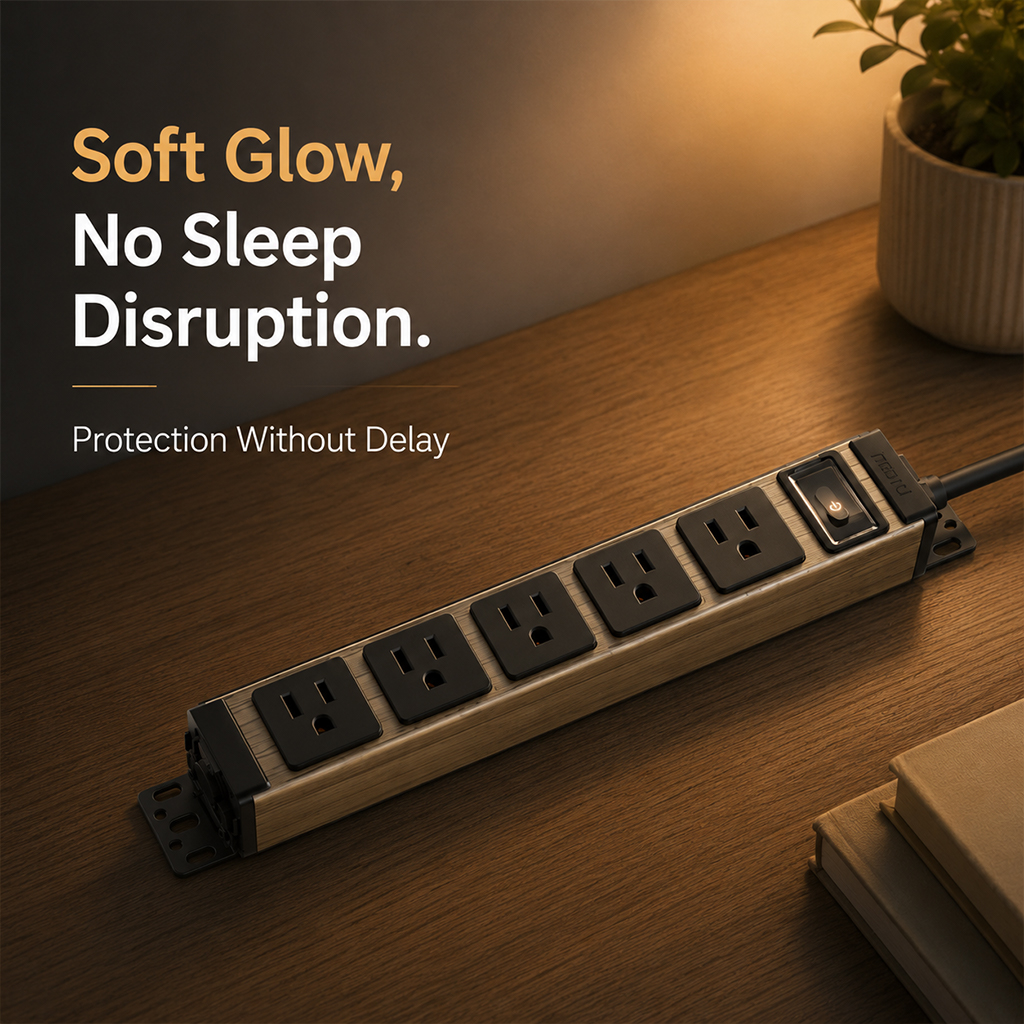
Consider a hybrid implementation example. A 5 outlet aluminum PDU power strip with circuit breaker serves as an excellent bridge. It provides heavy-duty reliability for workbench environments or small-rack setups where massive vertical units are unnecessary. This type of unit gives you the robust aluminum construction and reliable circuit protection of a full-sized rack unit, but in a compact form factor suitable for a test bench or a small wall-mounted network cabinet.
A massive misconception surrounds surge suppression. Not all strips are surge protectors. Conversely, not all dedicated units include surge protection. You must verify the specific capabilities of your chosen hardware. Many people mistakenly believe that any multi-outlet device will protect their computer from a lightning strike. In reality, basic multi-outlet devices offer zero protection against voltage spikes.
Metal Oxide Varistors (MOVs) handle surge protection in consumer devices. They degrade over time with every small surge they absorb. They fail without warning. This poses a significant fire risk under heavy-load scenarios when the protection silently vanishes. Once the MOVs inside a consumer surge protector degrade completely, the device continues to pass power to your equipment, leaving it completely vulnerable to the next voltage spike without any visual indication that the protection has failed.
Enterprise integration takes a different approach. Commercial units often intentionally omit local surge protection. This prevents single-point failures at the rack level. They rely instead on clean, conditioned power from upstream Uninterruptible Power Supplies (UPS) and building-wide surge suppression systems. By centralizing power conditioning at the UPS level, facility managers ensure that all downstream equipment receives perfectly stable sine-wave power, eliminating the need for redundant and potentially unreliable MOVs at the rack level.
Advanced remote management protocols simply do not exist in consumer strips. Smart units offer IP-based remote monitoring. They feature SNMP integration for centralized management. You can utilize environmental sensor inputs and configure automated load shedding during power events. These capabilities allow network administrators to monitor power consumption across hundreds of racks from a single centralized dashboard, identifying potential overload conditions before they cause a tripped breaker.
These features act as critical operational risk mitigation tools. Remote IT deployments require them to prevent overloads. They optimize capacity planning by providing granular power consumption data. You can identify stranded power capacity instantly. If a specific server locks up at a remote edge computing site, an administrator can log into the smart unit and cycle the power to that specific receptacle, restoring service in minutes without dispatching a technician to the physical location.
Feature | Standard Power Strip | Dedicated PDU |
|---|---|---|
Continuous Load Capability | Low (Intermittent only) | High (24/7 sustained) |
Enclosure Material | Plastic | Extruded Aluminum / Steel |
Mounting Options | Floor / Wall keyholes | 1U, 2U, 0U Rack-mountable |
Remote Management | None | Available (Smart models) |
Safety Certification | UL 1363 (Temporary) | UL 62368-1 (Continuous) |
High-density server environments demand rigorous power specifications. They require three-phase power support to handle massive loads efficiently. Locking receptacles, such as C13/C19 and NEMA L6, prevent accidental cord disconnections. Phase balancing becomes critical to optimize overall electrical efficiency across the facility. When deploying dozens of high-density blade servers, facility engineers must carefully distribute the load across all three phases of the incoming power supply to prevent phase imbalances that can trip main facility breakers and cause widespread outages.
The prosumer landscape requires robust power delivery. Home automation integration and high-density home labs push standard circuits to their limits. Enthusiasts need reliable hardware that mirrors enterprise stability without requiring massive facility upgrades. Running multiple enterprise-grade servers, storage arrays, and network switches in a basement rack generates significant continuous electrical loads that standard household extension cords cannot safely support.
Code-compliant integration remains paramount for residential PDU solutions. You must safely integrate these devices into standard 15A or 20A home circuits. Violating local electrical codes (NFPA 70) creates massive liability and fire risks. Always verify your wall receptacle matches the unit's input plug exactly. If your home is wired with standard 15-amp NEMA 5-15R receptacles, you cannot safely adapt a 20-amp or 30-amp unit to fit that outlet without risking a severe electrical fire inside your walls.
Audio-visual equipment presents unique power needs. Electromagnetic and radio frequency (EMI/RFI) noise filtration is mandatory to maintain signal clarity. Sequential power-up capabilities prevent blown speakers by staging equipment activation. Rack-mount aesthetics also play a significant role in professional studio environments. When powering up a massive amplifier rack, turning everything on simultaneously can cause a massive inrush current that trips the circuit breaker. Sequential units solve this by turning on each receptacle with a slight delay, smoothing out the power draw.
Upfront costs differ significantly between consumer and professional power devices. However, evaluating the purchase strictly on initial outlay ignores the broader operational picture. You must assess the value of the equipment connected to the device. Plugging twenty thousand dollars worth of networking equipment into a cheap plastic strip represents a massive failure in risk assessment. The physical infrastructure supporting your hardware must match the reliability requirements of the hardware itself.
Risk mitigation provides massive return on investment. Calculate the potential cost of equipment replacement. Factor in the devastating impact of data loss. Add the cost of downtime caused by a melted consumer strip. The protective investment of a dedicated unit easily justifies itself. When a critical database server goes offline because a cheap plastic housing melted under continuous load, the resulting loss of productivity and potential data corruption far exceeds the cost of proper power distribution hardware.
Operational efficiency improves dramatically with smart units. They reduce operational costs through remote troubleshooting. You eliminate unnecessary site visits just to reboot a locked server. Granular control saves time, fuel, and labor resources. For managed service providers overseeing equipment across multiple client sites, the ability to remotely cycle power on a frozen firewall router transforms a costly two-hour truck roll into a simple two-minute remote operation.
Circuit overloading hazards present severe structural and fire dangers. "Daisy-chaining" consumer strips violates basic electrical safety principles. Dedicated units utilize localized branch circuit breakers. These breakers mitigate localized overloads before they threaten the upstream facility infrastructure. Daisy-chaining multiplies the electrical resistance across multiple cheap connection points, generating excessive heat that frequently leads to electrical fires hidden behind desks or inside cabinets.
Regulatory standards compliance is non-negotiable. Commercial and industrial settings require strict adherence to OSHA, UL, CE, and NEC requirements. Deploying uncertified devices creates immense corporate liability. Always verify the certification stamps on your power hardware. Insurance inspectors and fire marshals actively look for uncertified or improperly deployed power strips during facility audits, and finding them can result in immediate citations or voided insurance policies in the event of a fire.
Thermal management directly impacts rack stability. Improper placement obstructs rack airflow. This leads to severe thermal issues and equipment throttling. Implement strict cable routing best practices. Keep exhaust paths clear and secure heavy power cables to the rack frame. When mounting vertical units, ensure they sit far enough back in the rack profile so they do not block the hot air exhausting from the rear of your servers. Blocked exhaust fans force servers to ingest their own hot air, leading to rapid thermal shutdowns.
Consumer strips handle temporary or low-draw consumer needs adequately. However, any infrastructure housing critical, expensive, or high-draw equipment requires a dedicated unit. Upgrading protects your hardware, ensures compliance, and guarantees continuous operation. Proper power distribution forms the foundation of any reliable technology deployment, whether in a massive data center or a dedicated home lab.
Take the following next steps to secure your infrastructure:
Audit your current total amperage draw across all connected devices to establish a baseline load.
Inspect your wall receptacle type to ensure physical compatibility with your chosen power hardware.
Map your rack space to determine if you need a horizontal 1U/2U or a vertical 0U mounting profile.
Remove any daisy-chained consumer strips immediately to eliminate existing fire hazards.
Consult with an infrastructure specialist to select the correct unit for your specific continuous load requirements.
A: Yes, it is technically possible if the input plug matches your wall outlet. However, it is generally overkill for basic needs. They lack the form factor convenience of a floor strip and are designed for rack mounting.
A: Basic units distribute power but rely on upstream UPS systems or facility surge protection. While some specific models include internal surge suppression, you should never assume surge protection is built-in without verifying the spec sheet.
A: UL 1363 covers temporary relocatable power taps and consumer strips. UL 62368-1 certifies audio/video and IT equipment power systems designed for permanent, continuous deployment in demanding environments.
A: It monitors the electrical current passing through the unit. If the load exceeds the safe threshold, the breaker trips to cut power. This protects both the connected equipment and the facility's electrical infrastructure from overloads.
A: They are completely safe provided the unit's input plug matches the wall receptacle. You must also ensure the total combined load of all connected devices does not exceed the circuit's continuous rating.


