
Views: 0 Author: Site Editor Publish Time: 2026-02-11 Origin: Site


The greatest threat to your critical infrastructure uptime is rarely the dramatic lightning strike hitting the roof. Instead, the true "silent killer" of sensitive electronics is the internal switching transient. Industry data suggests that nearly 80% of all electrical damage in data centers and industrial sites originates from inside the facility—caused by cycling HVAC systems, elevator motors, or heavy machinery. These daily, repetitive spikes degrade power supplies and corrupt data silently over time.
To combat this, the surge protection PDU serves as the "last meter" of defense. It acts as the critical "Type 3" protection layer required by modern compliance standards, bridging the gap between the building's main switchboard and your server rack. Moving beyond simple power distribution, these units offer hot-swappable maintenance, industrial ruggedness, and significant total cost of ownership (TCO) advantages. In this guide, we explore the specific operational benefits that make advanced SPDUs essential for mission-critical reliability.
The "10-Meter Rule": Building-level surge protection is ineffective for sensitive equipment located more than 10 meters away; PDUs bridge this gap.
Zero-Downtime Maintenance: Modern "20KA hot-swappable" modules allow surge components to be replaced without powering down the rack.
Data Integrity: SPDUs do more than prevent fires; they reduce electromagnetic interference (EMI/RFI) that causes data corruption.
Industrial Resilience: Specialized units are required for high-risk environments like base stations and manufacturing floors.
Many facility managers mistakenly believe that a lightning arrestor at the main service entrance (Type 1 protection) provides total coverage. While this absorbs massive external energy, it leaves a dangerous gap deep within the facility.
Main switchboard protection handles catastrophic external grid events. However, it cannot see or stop the localized spikes generated downstream. Every time a heavy inductive load—like a chiller or a conveyor belt motor—cycles on or off, it sends a voltage spike back through the electrical system. These are "secondary surges."
These internal transients might not destroy a server instantly. Instead, they cause cumulative damage. They degrade the metal oxide varistors (MOVs) inside power supplies and weaken insulating materials. Over time, this leads to unexplained hardware failures. A dedicated SPDU at the rack level clamps these spikes instantly, neutralizing the threat before it reaches the IT load.
Physics dictates the effectiveness of surge protection. According to engineering principles referenced in standards like EN 50600-2-2, surge protection devices (SPDs) lose their effectiveness over distance due to cable impedance and inductance. If the clamping device is more than 10 meters (approximately 33 feet) away from the equipment it is meant to protect, the "let-through" voltage may be too high to prevent damage.
Rack-mount PDUs solve this proximity problem. By placing the suppression components mere inches from the server inputs, they eliminate cable inductance risks. This proximity ensures that the clamping voltage remains low enough to protect delicate logic boards and processors.
Power lines are not the only entry point for destructive energy. Surges frequently enter via communication lines, such as PoE (Power over Ethernet) or signal cables, and then exit through the equipment's power connection to the ground. This "backdoor" entry can fry a motherboard even if the power input is clean.
Comprehensive protection requires a holistic approach. High-quality PDUs often integrate grounding studs or support architectures that ensure a common ground reference for all equipment in the rack. This shielding helps divert stray energy safely to the earth, preventing it from arcing across sensitive components.
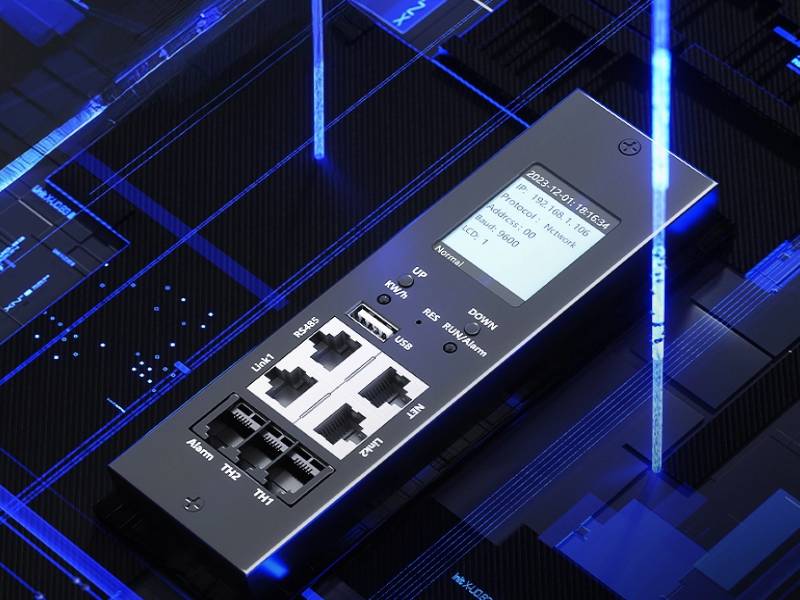
In high-availability environments, taking a rack offline to replace a power strip is unacceptable. This operational constraint has driven significant innovation in PDU design.
Traditional surge strips are often "sacrificial" by design. When their internal MOVs absorb a massive spike, they fail safely to protect the load. However, this leaves the strip functioning merely as an extension cord with no protection. To restore protection, you typically must power down the rack, unplug everything, and replace the entire unit.
The solution is the 20KA hot-swappable surge protection PDU. These advanced units feature modular surge cartridges. If a module sacrifices itself to stop a spike, maintenance personnel can physically remove and replace the surge module while the PDU continues to energize the servers. This capability is a critical decision criterion for data centers where 24/7 uptime is mandatory.
Cheap power strips rely on "dummy lights"—simple LEDs that turn off when protection is lost. In a dark server room or a remote cabinet, these lights often go unnoticed until equipment fails. Enterprise-grade SPDUs offer active signaling.
These units often include dry contacts or digital integration. You can wire the surge status directly into a Building Management System (BMS) or Data Center Infrastructure Management (DCIM) software. When protection is compromised, the system sends an immediate alert to the operations team, allowing for preemptive maintenance before the next surge occurs.
Not all electronics reside in climate-controlled clean rooms. From cell towers to factory floors, equipment faces physical and electrical hostility that consumer-grade strips cannot survive.
Telecom infrastructure faces unique threats. A base station surge protection PDU is specifically engineered for environments where lightning induction is a frequent occurrence due to tower height. These units require significantly higher energy absorption ratings (Joules) than office equipment.
Furthermore, telecom applications often operate on specific voltage standards, such as -48V DC or high-voltage AC (208V/400V). Using a standard office PDU in a base station is a recipe for failure. Specialized telecom SPDUs offer lower clamping voltages tuned to these specific power architectures, ensuring radio heads and switches remain operational during storms.
In manufacturing plants or construction zones, an industrial surge protection pdu must withstand dust, moisture, and impact. Plastic housings typical of consumer strips become brittle and crack under thermal stress or physical abuse.
Industrial units feature heavy-gauge steel or aluminum chassis. They are rated for high operating temperatures, often exceeding 60°C, and carry IP54 or higher ratings for resistance to dust and splashing water. Additionally, in construction contexts, these PDUs frequently integrate Ground Fault Circuit Interrupters (GFCI) to protect personnel from electrical shock in wet conditions.
| Feature | Standard Consumer Strip | Industrial Surge Protection PDU |
|---|---|---|
| Housing Material | Plastic / Polycarbonate | Steel / Aluminum Extrusion |
| Maintenance | Disposable (Single Use) | Hot-Swappable Modules |
| Temperature Rating | Max ~40°C | Max 60°C+ (Industrial Grade) |
| Protection Type | Basic MOV | Hybrid (MOV + Gas Discharge Tube) |
Surge protection is not just about preventing smoke and fire; it is also about preserving the accuracy of the data your systems process.
Electrical lines act as antennas, picking up Electromagnetic Interference (EMI) and Radio Frequency Interference (RFI) from nearby equipment like Variable Frequency Drives (VFDs) or fluorescent lights. This "noise" creates a dirty sine wave.
While standard surge protection clamps voltage spikes, advanced SPDUs also perform power conditioning. They filter out high-frequency noise that can cause "soft errors"—such as random bit flips in memory or audio artifacts in AV setups. For precision instruments and high-speed data transmission, verified dB attenuation is a critical specification that separates professional gear from generic power strips.
The "cumulative stress" theory explains why hardware fails prematurely. Small, repetitive surges that don't trigger a breaker still generate heat and stress within the capacitors of a server's Power Supply Unit (PSU). Over time, this stress reduces the component's Mean Time Between Failures (MTBF).
Investing in a high-quality PDU acts as a buffer. By smoothing out these irregularities, you reduce the thermal and electrical load on the PSUs connected to it. The Return on Investment (ROI) comes not just from preventing catastrophic loss, but from extending the operational life of every asset in the rack.
When evaluating infrastructure costs, procurement teams must look beyond the initial purchase price.
The cost calculation for an SPDU is straightforward. You must compare the price of the PDU against the aggregate cost of:
(Downtime Revenue Loss) + (Hardware Replacement Cost) + (Data Recovery Services) + (Labor for Emergency Repairs).
A single prevented outage often pays for the PDU ten times over. Furthermore, many industrial insurance policies now require verified Type 3 surge protection for coverage eligibility on sensitive electronics. Installing compliant SPDUs ensures you meet these requirements, potentially lowering premiums or avoiding claim denials.
When selecting a unit, look for these specific metrics to ensure performance matches your risk profile:
Clamping Voltage: The voltage at which protection activates. Lower is better (e.g., <400V for 120V systems, <700V for 230V systems).
Response Time: Must be in the nanosecond range (<1ns) to catch fast-rising transients.
Max Surge Current: A rating of "20kA" (20,000 Amps) is a standard baseline for robust rack-level defense.
Form Factor: Choose 1U horizontal for low density or 0U vertical to save rack space for servers.
A surge protection PDU is effectively an insurance policy for the "last meter" of your power delivery network. While building-wide protection handles the grid, the PDU defends against the internal enemies—the inductive loads and switching transients—that cause 80% of electrical failures.
For mission-critical operations, we recommend moving away from disposable plastic strips. Prioritize units that offer hot-swappable modules, metal construction, and verified clamping performance. These features ensure that your defense system does not become a point of failure itself.
Call to Action: Conduct a power path audit today. Identify any "unprotected" racks located more than 10 meters from your main distribution panel and upgrade them to Type 3 protection immediately to secure your uptime.
A: A standard PDU acts merely as a distributor, splitting one power input into multiple outlets. It offers no defense against electrical anomalies. A surge protection PDU (SPDU) actively monitors the voltage. It contains components like Metal Oxide Varistors (MOVs) that clamp excess voltage spikes and divert dangerous energy away from connected equipment, preventing hardware damage.
A: Yes. Building-level arrestors (Type 1) only stop external surges from the grid or lightning. They do not stop internal surges caused by equipment within your building. Furthermore, surge protection loses effectiveness over distance (the "10-meter rule"). You need a PDU to provide Type 3 protection directly at the rack level.
A: "Hot-swappable" means you can replace the surge protection module without turning off the PDU or the connected servers. In traditional units, if the protection blows, you must unplug the whole strip. With a hot-swappable design, you simply pull out the spent cartridge and insert a new one while the rack remains powered.
A: While higher Joule ratings generally indicate longer life, the specific requirement depends on the environment. For office settings, 1000+ Joules is often sufficient. For industrial or "base station" use, look for 3000+ Joules. However, clamping voltage and response time are often more critical metrics for equipment safety than the Joule rating alone.
A: No. A surge protection PDU protects against too much voltage (spikes). It cannot fix too little voltage (brownouts or sags). To protect against low voltage or power loss, you need an Uninterruptible Power Supply (UPS) with battery backup.


