
Views: 0 Author: Site Editor Publish Time: 2026-03-18 Origin: Site


In today's hyper-connected world, the reliability of remote base stations and bustling data centers is non-negotiable. However, a single lightning strike or power grid fluctuation can introduce a catastrophic overvoltage event, causing widespread hardware failure. A standard power distribution unit is simply not equipped to handle these threats. This is where a specialized Base Station Surge Protection PDU becomes indispensable. It serves as a robust power protection barrier for your most critical assets, including servers, storage arrays, and networking gear. This guide will evaluate the top ten features that separate enterprise-grade surge protection PDUs from their consumer-grade counterparts. We will focus on the technical specifications that guarantee 24/7 uptime and give you peace of mind, ensuring your infrastructure remains resilient against the unpredictable nature of electrical power.
Multi-Stage Defense: Effective PDUs combine MOV, TFMOV, and TVS technologies for nanosecond response times.
Industrial Compliance: Look for IEC 61643 standards and high Joule ratings (>1000J) for long-term durability.
Operational Intelligence: Remote monitoring and SPD status indicators are non-negotiable for unmanned base stations.
Physical Security: Locking sockets and high-temperature resilience (up to 60°C) prevent accidental downtime.
The most effective surge protection is not a single component but a coordinated, multi-stage defense system. Think of it as a series of filters, each designed to stop progressively smaller threats. An enterprise-grade PDU orchestrates several technologies to neutralize power transients before they can reach your sensitive equipment.
The first line of defense is typically the Metal Oxide Varistor (MOV). MOVs are the workhorses of surge protection, capable of diverting massive amounts of current from powerful surges. However, MOVs can degrade over time after absorbing multiple hits. In a failure scenario, they can overheat and pose a fire risk. To mitigate this, high-quality PDUs incorporate Thermally Protected MOVs (TFMOV). These components include a thermal fuse that disconnects the MOV from the circuit if it overheats, eliminating the risk of a thermal runaway event and ensuring safe end-of-life operation.
While MOVs handle the brute force of a surge, they can be slow to react (in electronic terms) and may allow a small amount of residual overvoltage to pass through. This is where Transient Voltage Suppression (TVS) diodes come in. TVS diodes have a much faster, nanosecond-level response time. They act as a precision tool, clamping down on the fast-rising transients and residual voltage that the MOVs might miss. This combination ensures that both high-energy and high-speed threats are effectively neutralized.
Surge Protective Devices (SPDs) are classified into types based on their location and capability within an electrical system. A building’s main service entrance might have a Type 1 or Type 2 SPD to handle direct lightning strikes. A surge protection PDU, however, must be rated as a Type 3 SPD. This classification signifies it is designed for "point-of-use" protection, located close to the sensitive electronic loads it protects. It provides the final, crucial stage of defense against internally generated surges (e.g., from HVAC systems cycling) and any residual energy that gets past the upstream SPDs.
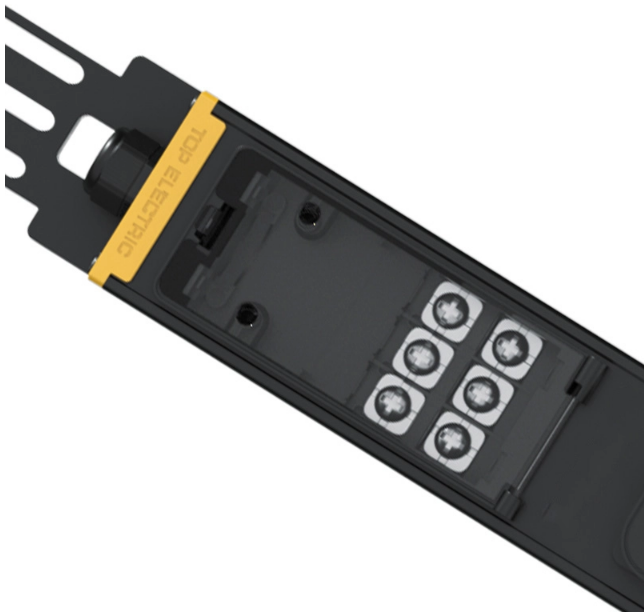
Understanding the energy handling capacity of a PDU is critical to evaluating its long-term effectiveness. While a high Joule rating is often a key marketing point, it must be considered alongside other crucial metrics to get a complete picture of the protection offered.
The Joule rating of a PDU indicates the total amount of energy its surge protection components can absorb before they fail. Think of it as the device's "health bar." Each surge it suppresses depletes a portion of this capacity. For mission-critical applications, you should look for ratings between 1000 and 2500 Joules. This ensures the PDU can withstand multiple, smaller surge events or a few significant ones over its lifespan without immediate degradation. A lower rating might mean the protective elements are sacrificed after a single major event, leaving your equipment vulnerable.
Perhaps even more important than the Joule rating is the clamping voltage, also known as the Voltage Protection Rating (VPR). This metric tells you the maximum voltage that the PDU will allow to pass through to your connected equipment. A lower clamping voltage is always better. For example, a PDU with a 330V clamping voltage will stop a surge far more effectively than one with a 500V rating. Sensitive server power supplies have a limited dielectric strength; exposing them to high VPR levels can cause immediate or latent damage. Always prioritize a PDU with the lowest possible clamping voltage for the given application.
| Metric | What It Measures | What to Look For | Why It Matters |
|---|---|---|---|
| Joule Rating | Total energy absorption capacity | 1000J - 2500J+ | Indicates device longevity and ability to withstand multiple events. |
| Clamping Voltage (VPR) | Maximum let-through voltage | Low (e.g., 330V, 400V) | Directly impacts the safety of sensitive connected electronics. |
| Response Time | How quickly it reacts to a surge | < 1 nanosecond | Crucial for stopping fast-rising electrical transients before they cause damage. |
When evaluating the total cost of ownership (TCO), consider the trade-off between a PDU's initial cost and its Joule rating. A higher-rated unit may cost more upfront but will likely have a longer service life, especially in areas with frequent power disturbances. This reduces the frequency of replacements and the associated maintenance labor. Over a 5 to 10-year lifecycle, a more robust PDU often proves to be the more economical choice by preventing costly equipment failures and downtime.
In unmanned locations like cellular base stations or remote edge computing sites, physical inspection is impractical and expensive. Intelligent PDUs with remote management capabilities are therefore not a luxury but a necessity for ensuring operational continuity.
The most critical intelligent feature is the ability to monitor the health of the Surge Protective Device (SPD) module itself. As the SPD components absorb surges, they degrade. A "dumb" PDU might have a simple LED indicator, which is useless if no one is there to see it. A networked PDU can send automated alerts via SNMP, email, or a web-based dashboard the moment the protection is compromised or depleted. This proactive warning allows technicians to schedule a replacement before the next surge event occurs, preventing a situation where you have a false sense of security.
Many advanced PDUs include ports for connecting external environmental sensors. These can monitor critical parameters like ambient temperature and humidity within the rack. High temperatures can drastically reduce the lifespan of IT equipment and even affect the performance of the PDU's protective components. Receiving alerts for environmental threshold breaches allows you to address potential cooling failures before they lead to a thermal shutdown or permanent hardware damage.
Intelligent PDUs often provide billing-grade accuracy for power monitoring at the outlet or unit level. They measure key metrics like current (Amps), voltage (Volts), active power (Watts), and energy consumption (kWh). This data is invaluable for several reasons:
Capacity Planning: Understanding power consumption trends helps you plan for future growth without over-provisioning circuits.
Overload Prevention: You can set alerts to warn you if a circuit is approaching its maximum load, preventing a tripped breaker during a critical moment.
Troubleshooting: Real-time power data helps diagnose issues with specific pieces of equipment remotely.
The physical design and construction of a PDU are just as important as its electronic components. A well-built unit enhances safety, simplifies installation, and ensures long-term physical resilience in demanding environments.
The choice of form factor depends on your rack density and power distribution strategy.
Horizontal (1U/2U): These units mount horizontally in the rack, occupying 1 or 2 units of valuable vertical space. They are ideal for smaller racks or when you need easy front-access to outlets.
Vertical (0U): These long, thin PDUs mount vertically in the side of the rack, consuming no "U" space. This is the preferred choice for high-density deployments as it maximizes space for servers and networking gear and simplifies cable management by running power directly down the back of the rack.
Use this simple chart to guide your decision:
| Factor | Choose 0U (Vertical) If... | Choose 1U/2U (Horizontal) If... |
|---|---|---|
| Rack Space | You need to maximize U space for IT equipment. | You have ample U space available. |
| Outlet Density | You need a large number of outlets (up to 48+). | You only need a few outlets (typically 8-16). |
| Cable Management | You want to reduce cable clutter at the back of servers. | Your cabling needs are simple and localized. |
For industrial or high-density environments, an all-steel or aluminum enclosure is a must. Plastic housings found on consumer-grade power strips are not suitable. A metal chassis provides superior durability, better heat dissipation, and essential electromagnetic shielding (EMI). In a dense rack filled with high-frequency electronic equipment, EMI can cause interference and data corruption. A robust metal enclosure helps contain this "noise" and protects the PDU's internal circuitry.
One of the most common causes of unplanned downtime is accidental power cord disconnection. This can happen due to rack vibrations or a simple mistake during maintenance. Locking IEC sockets (like the C13 and C19 used for most servers) prevent this. They use a retention mechanism to secure the power cord, ensuring a solid connection that won't come loose. This simple mechanical feature is critical for "set and forget" deployments in remote base stations.
Remote base stations and edge data closets are rarely the climate-controlled environments of a traditional data center. They are often subject to extreme temperature swings, making high-temperature resilience a critical PDU feature.
Standard office-grade power strips are typically rated for a maximum operating temperature of around 40-45°C (104-113°F). However, inside a sealed, densely packed equipment cabinet exposed to direct sunlight, ambient temperatures can easily exceed this. Enterprise-grade PDUs designed for these environments are rated to operate continuously at temperatures up to 60°C (140°F) or even higher. This high-temperature tolerance ensures reliable performance and prevents premature failure of electronic components.
It's important to understand that the performance of electronic components, including surge suppressors, can change with temperature. Manufacturers may provide "de-rating" curves in their technical specifications. This shows how much the maximum current load or other performance metrics must be reduced as the ambient temperature increases. When planning your power budget, always account for these de-rating factors to ensure you are not operating the PDU beyond its safe limits in a high-heat environment.
Verification of safety and compliance is non-negotiable. Look for PDUs that meet internationally recognized standards for information technology equipment safety. Key certifications include:
IEC 62368-1: This is the modern, hazard-based standard that is replacing older standards like IEC 60950-1. It covers audio/video, information, and communication technology equipment.
UL 60950-1: A widely recognized safety standard in North America for IT equipment.
IEC 61643-11: This standard specifically covers the performance requirements and testing methods for low-voltage SPDs like those found in a PDU.
Compliance with these standards demonstrates that the product has undergone rigorous testing for electrical safety and performance.
Choosing the right PDU involves more than just matching specs; it requires a holistic view of your entire power chain and operational needs. Asking the right questions upfront can prevent costly mistakes and ensure your investment is future-proof.
A common question is whether a surge-protected PDU is necessary when an Uninterruptible Power Supply (UPS) is already in place. The answer is almost always yes. While a UPS provides excellent battery backup and some level of surge protection, it doesn't eliminate the need for downstream defense. Surges can be generated *within* the facility, downstream from the UPS. Furthermore, a high-quality Type 3 SPD in the PDU provides a final, precise layer of protection tailored to the sensitive electronics plugged directly into it. It's about creating redundant layers of defense.
Many critical servers and network devices come with redundant power supplies. However, less expensive, single-corded equipment presents a single point of failure. A PDU with an integrated Auto Transfer Switch (ATS) solves this problem. The ATS PDU connects to two independent power sources (e.g., A-feed and B-feed). If the primary source fails, the ATS instantly switches to the secondary source, ensuring the single-corded device remains powered on without interruption.
Consider your long-term management strategy when choosing between PDU types. For mission-critical hardware, selecting the right Surge Protection PDU Data Center Computer Rooms provide is essential. Your choice may evolve over time.
Basic PDUs: Offer reliable power distribution with surge protection but no remote intelligence. Suitable for small, easily accessible racks.
Metered PDUs: Provide local or remote monitoring of power consumption, helping with capacity planning and preventing overloads.
Switched PDUs: Offer the highest level of control, allowing you to remotely turn individual outlets on or off. This is invaluable for rebooting locked-up equipment in an unmanned location, saving a costly truck roll.
Even the best PDU can be rendered ineffective by improper installation. Avoid these common mistakes:
Daisy-Chaining: Never plug one PDU or power strip into another. This can overload the original circuit and is a serious fire hazard. Each PDU should be connected directly to a dedicated branch circuit.
Improper Grounding: Surge protection relies on a solid, low-impedance path to ground to divert excess current. Ensure your facility has a proper single-point grounding system. Poor grounding or ground loops can actually bypass the protective circuitry, directing surge energy into your equipment.
Investing in a high-quality Base Station Surge Protection PDU is a strategic shift from reactive repair to proactive resilience. It's about acknowledging that power quality is a foundational element of IT infrastructure reliability. By prioritizing features like a multi-stage suppression architecture, robust energy absorption ratings, and intelligent remote management, you can build an impenetrable barrier for your core equipment. The ultimate goal is not just to distribute power but to guarantee that the power delivered is clean, safe, and continuous. This foresight significantly reduces equipment failure, minimizes maintenance overhead, and protects the services that drive your business forward.
A: Building-level SPDs (Type 1/2) are designed to handle large, external surges from sources like lightning. However, up to 80% of surges are generated internally from equipment like motors and HVAC systems. A point-of-use (Type 3) surge PDU is essential to clamp these internal transients and any residual overvoltage that gets past the main service entrance protection, safeguarding the sensitive electronics plugged directly into it.
A: There is no fixed schedule; replacement depends entirely on the number and magnitude of surge events the PDU has suppressed. The best practice is to choose a PDU with a clear "Protection Present" status indicator. For remote sites, this must be a networked alert. Check these indicators quarterly as part of routine maintenance and replace the module or unit as soon as the alert is triggered.
A: Not necessarily. While a higher Joule rating indicates a longer potential lifespan and greater energy absorption capacity, it's only one part of the equation. The clamping voltage (VPR) and response time are equally critical. A PDU with a very high Joule rating but a high clamping voltage could still allow damaging levels of voltage to reach your equipment. A balanced approach is best.
A: Absolutely. While their high-temperature resilience and robust build make them ideal for challenging base station environments, these features also provide an extra margin of safety and reliability in pristine data center computer rooms. They are perfect for any application housing high-value servers, storage arrays, or networking gear where uptime and equipment protection are paramount.


