
Views: 0 Author: Site Editor Publish Time: 2026-05-07 Origin: Site


Modern data centers face escalating power densities today. They also handle shrinking spatial footprints and strict Power Usage Effectiveness (PUE) mandates. Standardized power strips are no longer sufficient for these intense demands. Intelligent power distribution serves as a critical layer of IT infrastructure risk management.
Selecting the right power distribution unit mitigates serious downtime risks. It resolves hidden cooling inefficiencies effortlessly. It also provides the granular telemetry necessary for accurate capacity planning. You need this data to maintain a healthy IT ecosystem.
This guide unpacks the hierarchy of data center power distribution. We categorize the core types of PDU in data center racks. We also provide an evidence-based framework for your facility. You will learn how to evaluate vendor specifications and custom configurations confidently.
Macro vs. Micro: Power distribution requires both primary facility transformation (Floor PDUs/Busways) and rack-level delivery (Rack PDUs).
Intelligence Tiers: Rack PDUs range from unmanaged basic units to switched intelligent models capable of remote rebooting and socket-level metering.
Efficiency Gains: Transitioning to 400V three-phase power and utilizing high-temperature-rated PDUs can yield measurable reductions in step-down transmission losses and cooling costs.
Risk Mitigation: Color-coded alternating phases and secure locking receptacles prevent load-balancing failures and accidental disconnects caused by human error.
Vendor Selection: Standardized global supply chains and access to custom PDU services are critical when vetting a power distribution unit manufacturer.
You must distinguish between facility-level infrastructure and cabinet-level distribution. This establishes accurate operational boundaries for your facility. Data centers manage electricity in stages. They move power from the main utility grid down to individual server components. We break this hierarchy into two primary distribution levels.
Floor-mounted units handle the massive electrical load entering the building. They function as large-scale step-down transformers. They take high-voltage facility power, such as 480V AC. They convert it into a usable server voltage, typically 208V or 120V.
These units are massive. They are designed for 300kVA+ capacities. Facilities heavily utilize specific form factors to route power to individual server rows. These forms include:
Power Distribution Cabinets: Standalone cabinets housing large transformers and sub-feed breakers.
Remote Power Panels (RPPs): Sub-panels placed closer to server rows. They utilize existing transformers to feed localized circuits.
Overhead Busways: Modular electrical tracks suspended above the cabinets. They act as power highways. You plug tap boxes into them directly.
Floor PDUs establish the foundation of your power infrastructure. They dictate how much raw energy reaches the actual IT racks.
Rack units serve as the final connection point in your power chain. They mount directly inside the server cabinet. You can find them in 0U, 1U, or 2U form factors. They distribute the stepped-down current directly to individual servers, network switches, and storage arrays.
You interact with rack PDUs daily. They bridge the gap between facility engineering and IT hardware management. They also offer varying levels of intelligence. This intelligence dictates how well you monitor and manage server energy consumption.
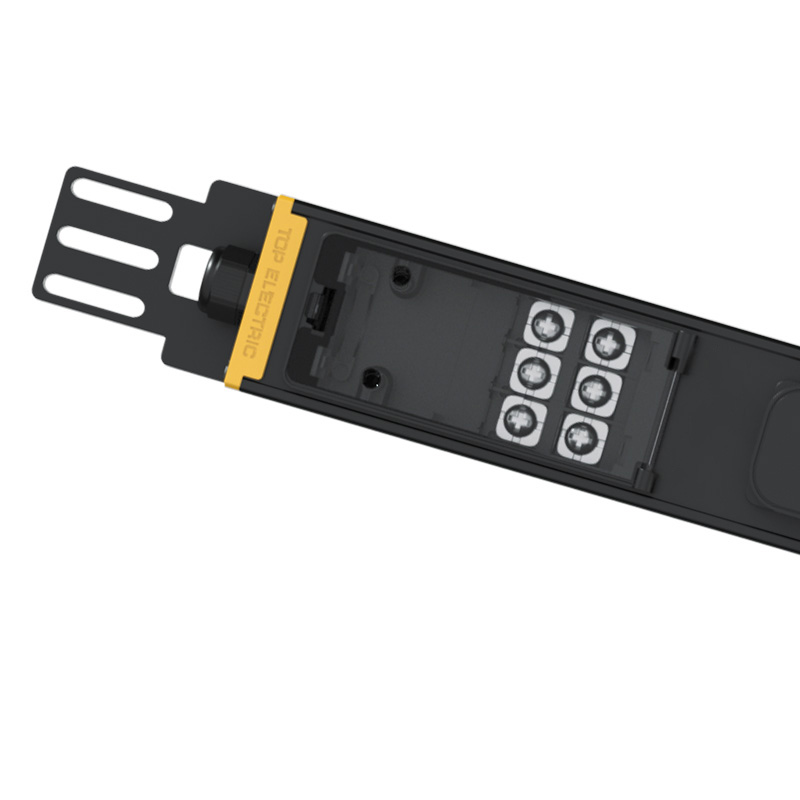
You must match the level of device intelligence to specific operational models. Different IT deployment scenarios require different monitoring capabilities. We classify rack power units into four distinct tiers.
Basic PDUs
Features: They provide reliable, unmanaged power delivery. They include foundational surge protection. They lack network connectivity or telemetry capabilities.
Best For: They suit small, locally managed server rooms perfectly. Staff are always on-site here. They also fit non-critical environments. Data visibility remains unnecessary in these specific scenarios.
Metered PDUs
Features: These units incorporate local LED or LCD displays. They indicate real-time amperage and load levels at the rack or phase level. You read the screen manually.
Best For: They benefit facilities needing local visual cues. Technicians use these cues to prevent circuit overloads during physical provisioning. They avoid the overhead of complex network integrations.
Monitored PDUs
Features: These network-connected units provide remote, real-time power metrics. They often support billing-grade accuracy. This accuracy stays within a ±1% margin down to the individual outlet level.
Best For: Colocation facilities rely on them heavily. They require accurate tenant billing. Large-scale environments also use them. They integrate Data Center Infrastructure Management (DCIM) software. This tracks overall efficiency and identifies underutilized "zombie" servers.
Switched (Intelligent) PDUs
Features: They combine granular monitoring with remote outlet toggling. Administrators can power-cycle unresponsive equipment instantly. You never need to dispatch remote hands for simple reboots.
Best For: Edge computing sites demand them. Unstaffed remote deployments require this control. High-density enterprise environments also need maximum automated control over their hardware.
The following table summarizes the operational capabilities across the four primary tiers. You can use it as a quick reference guide.
PDU Type | Network Connectivity | Local Display | Remote Metering | Remote Outlet Switching |
|---|---|---|---|---|
Basic | No | No | No | No |
Metered | No | Yes (Rack/Phase) | No | No |
Monitored | Yes | Yes | Yes (Outlet Level) | No |
Switched | Yes | Yes | Yes (Outlet Level) | Yes |
Evaluating physical and electrical specifications is crucial. These details dictate hardware compatibility. They also ensure future-proofing for next-generation server clusters. You must consider dimensions, wiring, and receptacle types.
Data center rack space holds immense value. Your mounting orientation directly impacts how many servers you can rack.
0U Vertical Profiles: They preserve critical U-space exclusively for compute hardware. They mount vertically along the back side of the cabinet. However, they require adequate cabinet depth. Shallow cabinets may pinch cables or restrict exhaust airflow.
1U/2U Horizontal Units: They are highly visible and accessible. They mount exactly like a standard server. Unfortunately, they consume revenue-generating rack space. You typically use them in smaller network racks rather than high-density compute rows.
High-density racks draw extreme amounts of power. Your electrical topology determines how efficiently that power arrives.
Single-Phase vs. Three-Phase: Single-phase power suits low-density setups. Three-phase power minimizes voltage fluctuations perfectly. It reduces heat generation across the distribution lines. However, three-phase necessitates careful phase balancing. You must distribute server loads evenly to prevent breaker trips.
The 400V Advantage: Standard designs step 480V down to 208V at the floor. Modern designs distribute 400V directly to the rack. They utilize Wye wiring topologies. This delivers 240V directly to the individual server. This method eliminates intermediate step-down transformers. You potentially reclaim 3 to 7% in end-to-end power efficiency.
Hardware power supplies dictate your required outlets. You must balance them carefully. Standard configurations balance C13 (15A) and C19 (20A) outlets. You base this ratio on your specific server density.
Universal/Combo Outlets: Manufacturers now offer modern C39 combo outlets. A single C39 receptacle accepts both C14 and C20 plugs interchangeably. This innovation drastically simplifies hardware refresh cycles. You rarely need to replace the entire rack power strip when upgrading servers. It provides excellent long-term flexibility.
Intelligent units move far beyond basic power delivery. They act as centralized network hubs for environmental monitoring and automated security. You can unlock immense operational value by utilizing these advanced features.
Intelligent units act as environmental hubs natively. Following strict ASHRAE guidelines, you should monitor rack temperatures continuously. Units should support plug-and-play daisy-chained sensors. You measure temperature and humidity at the top, middle, and bottom of the rack intake. This data helps you tune computer room air conditioning units perfectly.
Modern servers run hotter than legacy equipment. Your rack power strips must survive these elevated temperatures. High-quality units carry ratings for up to 140°F (60°C). This tolerance allows operators to raise ambient aisle temperatures safely. Warmer ambient temperatures yield significant cooling cost reductions for the facility.
Connecting hundreds of smart strips to a network can exhaust switch ports quickly. Advanced models solve this networking challenge elegantly.
IP Cascading/Aggregation: You can link up to 50 strips on a single IP address. This cascaded setup reduces top-of-rack switch port consumption dramatically. It simplifies your subnet architecture.
Out-of-Band Management: Primary network outages happen. Serial connections ensure administrators retain raw power control during these emergencies. You bypass the broken ethernet network entirely.
Network components fail eventually. You never want to power down production servers just to replace a broken network card. Premium models feature hot-swappable intelligence modules. You slide the network monitoring brain out safely. The internal bus bar continues delivering power to the connected servers without interruption.
Practical rollout considerations determine your project success. You must address compliance, safety risks, and custom engineering needs early. A careless deployment introduces unnecessary operational hazards.
Three-phase setups require strict load management. Moving a server to an incorrect outlet unbalances the load easily. This unbalance triggers a dedicated breaker trip. It creates cascading failovers. Mitigation requires specifying hardware with color-coded, alternating-phase receptacles. Alternating colors visually guide technicians. They distribute power evenly across phases without calculating loads manually.
Accidental unplugging causes entirely preventable outages. Technicians bump cables during routine maintenance frequently. Server fans create micro-vibrations over time. You should always specify locking receptacles. IEC grips physically lock the power cord into the outlet. They prevent accidental disconnects reliably.
Standard SKUs rarely fit every high-density layout perfectly. Sometimes cables run too long, blocking airflow. Sometimes you need a specific mix of C13 and C19 outlets.
Partnering with a specialized power distribution unit manufacturer solves these layout issues. They ensure you access localized compliance certifications like UL or CE automatically.
Furthermore, leveraging robust custom PDU services allows for highly tailored input configurations. You eliminate excess cable slack instantly. This prevents under-floor air blockage. Custom whips also align precisely with existing overhead busway tap boxes. It makes the final physical installation clean, safe, and highly efficient.
The decision to deploy Basic versus Switched models hinges on your facility’s specific tolerance for downtime. It also depends on your reliance on remote management. For enterprise and edge environments, the upfront premium of intelligent, high-temperature, 400V-capable equipment is rapidly offset. You gain immediate operational labor savings and measurable PUE improvements.
Take actionable steps today to secure your infrastructure. Audit your current rack power densities thoroughly. Calculate the potential operational returns of identifying idle servers via outlet-level monitoring. Finally, pilot a standardized intelligent configuration in a non-critical test row. Monitor the telemetry for thirty days before rolling the standard out globally across your footprint.
A: Metered PDUs display power consumption metrics locally on a physical screen on the unit itself. Monitored PDUs provide these same metrics over a network connection, allowing integration with DCIM software for remote capacity planning and alerting.
A: In a three-phase electrical system, drawing too much power from one phase while leaving others underutilized creates internal waste heat and can trigger the phase's dedicated circuit breaker. Proper balancing maximizes electrical efficiency and prevents localized outages.
A: By transmitting power at a higher voltage (400V) directly to the cabinet, data centers avoid the energy losses associated with stepping down power to 208V/120V at a floor-mounted transformer. This structural change can reduce overall power distribution losses by up to 7%.


