
Views: 0 Author: Site Editor Publish Time: 2026-05-05 Origin: Site


Generative AI and edge computing drive rack power demands 10x to 15x higher than legacy deployments. You can no longer treat the final link in your power chain as an afterthought. Industry data reveals 70% of data center outages tie directly to power supply issues. If the uninterruptible power supply acts as the reservoir ensuring business continuity, the power distribution unit serves as the critical pipeline. It dictates power delivery, equipment visibility, and physical control.
This complete PDU buying guide bypasses basic definitions to focus on advanced infrastructure needs. It provides IT architects and facility managers a solid technical framework for evaluating modern rack power infrastructure. You will learn how to evaluate capacity, intelligence, and form factor requirements effectively. Mastering these concepts helps you avoid thermal throttling, phase imbalances, and premature hardware replacements across your server deployments.
Capacity Planning Requires De-rating: Safety compliances (particularly in North America) dictate that maximum continuous load should not exceed 80% of the unit’s rated capacity.
Intelligence Follows a Matrix: Modern PDU selection is governed by a simple two-axis matrix: power visibility (unit vs. outlet level) and physical control (manual vs. remote switching).
Form Factor Impacts Cooling: Selecting standard vertical 0U PDUs without considering depth can obstruct server exhaust in high-density racks; ultra-low-profile designs are now a necessity for A/B redundant setups.
Hardware Quality Prevents False Trips: Look for hydraulic-magnetic breakers over standard thermal breakers to prevent false tripping in 60°C+ hot-aisle containment environments.
Modern data centers demand more than just robust power strips. Upgrading to intelligent power delivery systems transforms passive infrastructure into active management tools. You unlock significant operational advantages when you integrate smart capabilities into your rack environments.
Eradicating "Ghost Loads": Idle but connected equipment silently drains facility power. Switched units allow facility teams to remotely identify and terminate inactive ports. You directly improve your Power Usage Effectiveness (PUE) by systematically cutting off stranded power.
Minimizing "Truck Rolls": Dispatching technicians to remote edge sites drains resources. Integrated Auto-Probe features actively ping IP addresses. When network hardware freezes, the system automatically power-cycles the specific port. This automated recovery drastically reduces manual intervention.
Billing-Grade Accuracy: Colocation and high-density hosting environments require extreme precision. Achieving +/- 1% metering accuracy is no longer optional. It serves as the absolute baseline for enforcing SLA compliance and executing accurate tenant chargebacks.
The Network Security Trade-off: Upgrading to smart networked devices introduces new endpoint vulnerabilities. Proper implementation requires stringent access protocols. You must deploy SNMPv3, HTTPS, and SSH protocols. Seamless DCIM integration remains essential for monitoring these endpoints securely.
Selecting the right equipment requires balancing your need for data against your need for control. We categorize these devices along a simple matrix based on power visibility and remote management features.
PDU Category | Visibility Level | Control Capabilities | Best Use Case |
|---|---|---|---|
Basic (Unmanaged) | None | Manual only | Highly stable, low-density legacy loads requiring strict upfront simplicity. |
Metered | Unit-Level (Macro) | Manual only | Preventing phase imbalances and avoiding circuit overloads at the rack level. |
Monitored | Outlet-Level (Granular) | Manual only | Complex capacity planning and identifying specific power-hungry servers. |
Switched | Outlet-Level (Granular) | Remote Switching | High-density AI environments requiring remote reboots and power sequencing. |
Basic units provide cost-effective, zero-visibility distribution. They fit well in environments where configurations rarely change. Metered systems step up by providing local digital displays or remote macro-level load data. They become essential tools for monitoring overall phase balance.
Monitored systems deliver granular, per-receptacle power consumption data. They give you the exact metrics required for virtualization projects. Switched systems represent the top tier. They combine detailed outlet-level monitoring with remote reboot capabilities. They also offer sequential power-up sequencing. This specific feature prevents massive inrush current overloads when restoring power to heavily populated racks.
The physical geometry of your equipment dictates its impact on server health. Deploying improper chassis sizes often leads to severe thermal complications and cable management nightmares.
Data center engineers overwhelmingly favor 0U vertical systems. They mount flush against the rear rack rails. A single vertical unit can hold 40 or more receptacles without consuming usable U-space. This preserves maximum capacity for critical compute and storage hardware.
Horizontal systems typically occupy 1U or 2U of rack space. They remain restricted to 8-16 outlets. You should utilize horizontal configurations primarily in small telecommunication closets. They also work perfectly alongside in-row UPS deployments. Sometimes, strict rack depth limitations prohibit vertical mounting entirely.
Server racks continuously shift toward dual A/B redundant layouts. Two thick traditional units mounted side-by-side often block hot-aisle server exhausts. Obstructed airflow triggers immediate thermal throttling in modern AI processors. High-density environments now require ultra-low-profile chassis designs. These slimmer profiles guarantee adequate exhaust clearance while maintaining high receptacle counts.
Messy cables cause operational hazards. You can leverage color-coded alternating phase outlets to clean up cable management geometry drastically. Alternating phases simplify load balancing across three-phase systems. Furthermore, plug-lock inserts minimize human error. They physically prevent technicians from accidentally disconnecting vital server power during routine maintenance tasks.
Procuring robust infrastructure requires a methodical approach. Follow this six-step framework to ensure your selected hardware precisely matches your facility's operational demands.
Step 1: Calculate Maximum Headroom & 80% Rule. First, tally the maximum kW draw of all redundant and non-redundant equipment. Apply the 80% agency de-rating rule. For example, a 15A circuit safely supports a 12A continuous load according to North American safety compliances. Always leave an additional 20-30% power buffer for future hardware iterations.
Step 2: Single-Phase vs. Three-Phase Power. Standard closets usually run fine on 120V/208V single-phase power. However, 208V/400V three-phase architecture becomes mandatory for high-density environments. Three-phase delivery reduces wire thickness, lowers line losses, and minimizes dangerous heat accumulation in the cabinet.
Step 3: Receptacle Standardization. Hardware plugs evolve rapidly during hardware upgrade cycles. Specifying "Combination Outlets" eliminates major procurement risks. These unique receptacles function safely as both C13 and C19 connections. They prevent you from running out of the correct plug type during unexpected server migrations.
Step 4: Circuit Protection Mechanisms. High-density AI racks run incredibly hot. Reject cheap thermal breakers immediately. Ambient cabinet heat often causes them to trip falsely. You must mandate hydraulic-magnetic breakers. They guarantee reliable operation in 60°C (140°F) hot-aisle containment environments without degrading over time.
Step 5: Environmental Monitoring Readiness. Smart racks do more than deliver electricity. Ensure your chosen hardware supports hot-swappable communication modules. It should accept direct plug-ins for temperature, humidity, and water leak sensors. This turns your power strip into a complete environmental sentry.
Step 6: Assess Need for Customization. Off-the-shelf units sometimes fail to meet specific EMI/RFI filtering requirements for medical or industrial applications. They might also fail strict spatial constraints. Engaging a vendor for custom PDU services presents a much safer path. Custom engineering beats forcing an incompatible fit into a sensitive environment.
Evaluating your supply chain extends far beyond raw specifications. The right operational features streamline global deployments and reduce long-term management friction.
Network port consumption poses a major logistical hurdle when deploying intelligent endpoints. Assess if the hardware supports daisy-chaining multiple units together. IP aggregation allows you to link dozens of devices through a single IP address. This networking strategy significantly reduces the number of enterprise network switch ports required for intelligent infrastructure management.
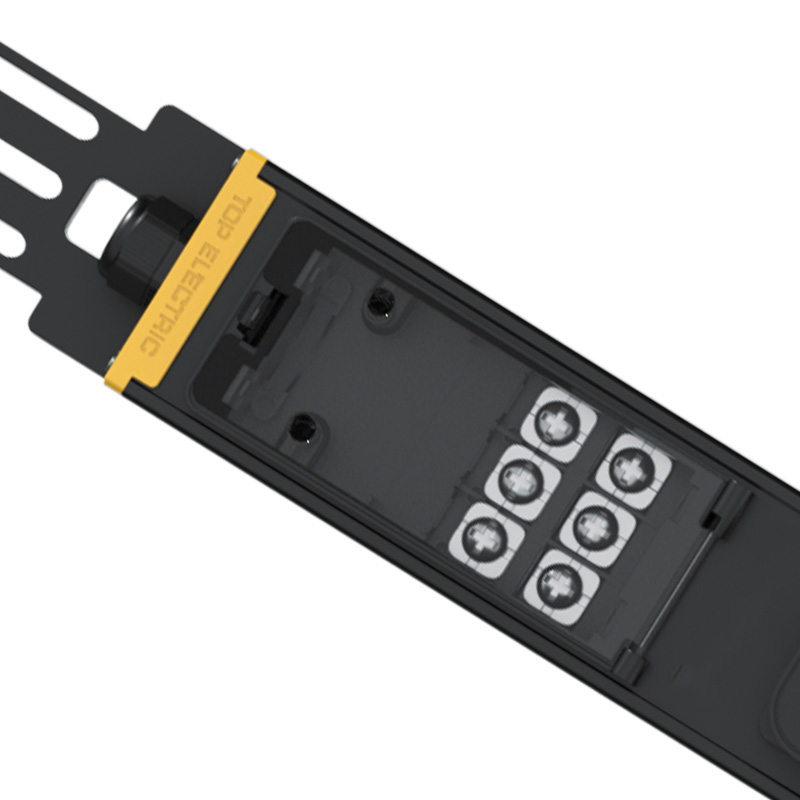
Global enterprises face extreme operational nightmares managing different SKUs for European, Asian, and American input voltages. Modern hardware solves this through Universal architecture. Look for units featuring specialized 7-pin modular connectors. They allow your teams to swap input power cords seamlessly. You keep the core base unit uniform globally while only adapting the localized facility connection cable.
You should not just buy a piece of hardware. Always evaluate the broader capabilities of your power distribution unit manufacturer. Investigate their supply chain transparency and firmware update frequency. Verify their warranty terms. Ensure they possess a robust DCIM software ecosystem compatibility. A reliable manufacturer provides continuous firmware security patches to protect your networked endpoints against emerging threats.
Selecting the correct unit shifts IT focus from reactive firefighting to proactive capacity management.
Modern rack outfitting requires balancing exact load limits, premium breaker quality, and remote control capabilities.
High-density AI deployments demand three-phase power, ultra-low-profile designs, and hydraulic-magnetic breakers to survive severe thermal loads.
Universal architectures and combination outlets future-proof your racks against rapid hardware evolution.
Before issuing an RFP or a purchase order, map out your three-year IT hardware roadmap accurately. Calculate your absolute total power draw. Utilize a dedicated vendor sizing calculator to configure your precise outlet, voltage, and phase requirements. Proactive planning ensures your power pipeline remains resilient.
A: Three-phase power delivers significantly more power over fewer wires. This architectural advantage reduces cable clutter inside the rack and lowers transmission heat generation. It easily supports high-density AI and blade server deployments exceeding 10kW per cabinet, making it essential for modern data centers.
A: To comply with North American safety codes like the NEC, continuous loads must never exceed 80% of a circuit's maximum amperage rating. This de-rating prevents chronic breaker tripping and ensures long-term electrical safety. For example, a 30A circuit safely provides 24A of continuous operational load.
A: Combination outlets feature a highly flexible receptacle design. They safely accept both standard C14 (lower power) and C20 (higher power) server plugs. This innovation eliminates the need to guess exact receptacle ratios during procurement, future-proofing your racks for unexpected hardware upgrades.
A: Yes. Enterprise-grade intelligent models feature hot-swappable network control modules. This modular design allows technicians to execute critical firmware upgrades or physically replace damaged controllers without ever interrupting the actual electrical flow to your connected servers.


