
Views: 0 Author: Site Editor Publish Time: 2026-02-06 Origin: Site


Unplanned downtime is rarely the result of a total utility grid collapse. More often, the culprit is "dirty power"—invisible transients, voltage spikes, and frequency irregularities that silently degrade hardware over time. For facility managers, these fluctuations present a significant operational risk. A single millisecond of unmitigated voltage surge can corrupt data or destroy power supplies, turning expensive infrastructure into dead weight. As rack densities scale to support AI and high-performance computing (HPC), the financial stakes of such damage increase exponentially.
Relying on basic power strips in this environment is a critical error. To safeguard mission-critical assets, IT architects must look beyond simple distribution and invest in industrial-grade surge protection PDU solutions. These units are engineered to act as sophisticated firewalls for electricity. This article explores the essential evaluation criteria, suppression technologies, and remote management features necessary to secure modern data center computer rooms. We will guide you through calculating the true total cost of ownership (TCO) to justify the investment in robust power protection.
Beyond the Strip: Enterprise PDUs offer multi-stage suppression (MOV + GDT) far superior to consumer-grade surge protectors.
Density Matters: Modern AI/HPC workloads (>40kW/rack) require PDUs that handle high amperage without compromising protection.
Remote Visibility: The best units combine surge protection with "Metered" or "Switched" capabilities for proactive maintenance.
TCO Reality: The cost of a premium PDU is a fraction of the replacement cost for servers and storage arrays damaged by transients.
Power quality issues are often categorized incorrectly. Many assume threats only come from outside the building, such as severe weather. While external strikes are devastating, they are statistically less frequent than the dangers originating from within your own walls.
External threats primarily involve high-energy events. Lightning strikes on facility service lines or grid switching at the utility substation can send massive voltage spikes rushing toward your equipment. These surges carry enough energy to instantly bypass standard fuses and melt circuit boards.
However, internal threats are more insidious. Every time a heavy inductive load cycles on or off—such as a CRAC unit, a backup generator, or even a laser printer on the same circuit—it creates a switching transient. These minor spikes happen thousands of times a day. They may not cause immediate smoke, but they inflict "electronic rust," slowly degrading logic boards and shortening the lifespan of power supply units (PSUs).
Data center power architecture relies on a tiered defense strategy. The facility-level UPS (Uninterruptible Power Supply) acts as the first line of defense, conditioning power and smoothing out major sags. However, the UPS cannot filter every downstream transient generated inside the server hall itself. This is where the rack PDU becomes critical. It serves as the last line of defense.
Your strategy must be to Build a power protection barrier for core equipment such as servers and storage arrays, and avoid equipment failures caused by lightning-induced overvoltage. By installing a high-quality surge protection PDU at the rack level, you isolate sensitive IT gear from residual noise that bypasses upstream filters. This isolation is vital for maintaining data integrity.
When protection fails, the results are costly. The most obvious outcome is immediate hardware destruction, where fried components require emergency replacement. More frustrating, however, is silent degradation. This manifests as inexplicable system bugs, random reboots, or corrupted data sectors in storage arrays. Technicians often waste hours diagnosing software issues, unaware that the root cause is unstable voltage reaching the logic gates.
Selecting an enterprise PDU requires analyzing specifications that go far beyond plug count. You must evaluate the unit's ability to divert energy and its physical suitability for your specific rack configuration.
Marketing materials often highlight "Joule ratings," but this metric can be misleading. A high Joule rating simply indicates how much total energy the device can absorb before failing. It does not tell you how much voltage it lets through to your servers.
| Specification | Why It Matters | Ideal Target |
| Clamping Voltage | The voltage level where the PDU starts diverting excess energy to ground. | Lower is better (e.g., 330V or 400V for 120V systems). |
| Let-Through Voltage | The residual voltage that passes through the PDU to the equipment during a spike. | Must be within the safe operating range of IT power supplies (UL 1449 defined). |
| Response Time | How quickly the suppression components react to a surge. | < 1 nanosecond. |
For mission-critical environments, prioritize Let-Through Voltage. A PDU with a massive Joule rating is useless if it reacts too slowly or allows a 1000V spike to pass through before clamping down.
Space is a premium commodity in data center computer rooms. Zero-U (Vertical) PDUs are the standard for high-density racks. They mount vertically in the rear channel of the cabinet, leaving all horizontal U-space available for servers. Look for tool-less button mounting systems to speed up deployment. Additionally, color-coded outlets help technicians visually balance phases without tracing cables.
In contrast, 1U or 2U (Horizontal) units are ideal for smaller wall-mount enclosures or specific base station surge protection PDU deployments where vertical height is restricted. These compact units provide the same level of protection but fit standard 19-inch mounting rails.
Modern racks are shifting away from single-phase power. To support densities above 10kW, 3-phase power is becoming the norm. This allows for more efficient power delivery and higher total amperage per rack.
On the output side, standardizing plugs is a challenge. Hardware vendors constantly switch between C13 and C19 plugs. To future-proof your investment, look for PDUs featuring "Universal" or hybrid outlets (such as the Cx or C39 standards). These receptacles accept both C14 and C20 plugs, eliminating the need to replace the entire PDU when you refresh your server hardware.
Heat management strategies like hot-aisle containment can push rear-rack temperatures significantly higher than the ambient room temperature. Standard power strips may degrade or trip thermally in these conditions. Ensure your PDU carries a high-temperature rating, ideally 60°C (140°F), to guarantee reliable operation in modern high-heat containment zones.
"Dumb" PDUs—essentially metal boxes with outlets—are blind spots in your infrastructure. You cannot manage what you cannot measure. Intelligent PDUs transform power distribution from a passive utility into an active management tool.
A basic surge strip offers protection but zero visibility. If a breaker trips or a server hangs, you have no way of knowing without physically inspecting the rack. Intelligent units bridge this gap by integrating network management cards that communicate status to your Data Center Infrastructure Management (DCIM) software.
Metered PDUs provide real-time data on voltage, amperage, and power factor. This visibility allows you to set proactive alerts. For example, you can configure the system to notify you if the load on Phase A approaches 80% capacity, preventing a circuit overload before it happens.
Accuracy is paramount here. For colocation providers who bill clients based on usage, "billing-grade" accuracy (typically ±1%) is a requirement, not a luxury. This ensures transparency and trust in chargeback models.
Switched PDUs offer the highest level of control. They allow administrators to remotely turn individual outlets on or off via a web interface. This capability is a game-changer for remote management:
Remote Reboots: If a server locks up at 3 AM, you can power cycle it instantly without dispatching a technician (saving a "truck roll").
Outlet Sequencing: You can program outlets to power on in a specific order with time delays. This prevents massive inrush currents from tripping the main breaker when power is restored after an outage.
Connecting a PDU to the network introduces a potential attack vector. Therefore, security protocols are non-negotiable. Ensure the management interface supports SNMPv3 (encrypted management traffic), HTTPS, and secure boot technologies. The PDU should act as a secure endpoint, not a backdoor for cyber threats.
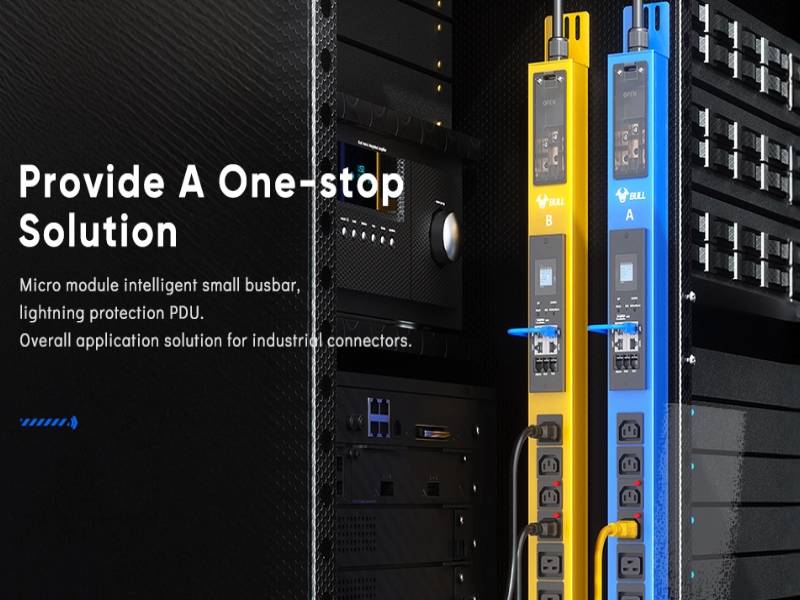
The rise of AI and edge computing is reshaping power requirements. A standard 5kW rack solution is no longer sufficient for GPU-dense clusters.
Artificial Intelligence workloads drive rack power densities to extreme levels, often exceeding 40kW or even 100kW in liquid-cooled scenarios. These high loads often utilize non-linear power supplies that generate harmonic distortion. This electrical noise can overheat neutral conductors and confuse standard metering equipment. High-density surge protection PDUs are designed to handle these massive currents while filtering out the harmonic noise that could destabilize the GPU cluster.
5G deployment requires placing compute power at the edge, often in unmanned towers or roadside cabinets. A base station surge protection PDU faces different challenges than a climate-controlled data center unit. It must be compact, ruggedized against humidity and dust, and capable of operating in wider temperature ranges. Furthermore, "watchdog" features are essential; the PDU can automatically ping a connected device and power cycle the outlet if the device fails to respond, ensuring uptime without human intervention.
Resilience requires redundancy. Most critical racks utilize an A/B feed architecture, drawing power from two separate UPS sources. It is imperative that surge protection is present on both feeds. If you only protect the primary side, a surge entering through the secondary failover line will bypass your defenses and destroy the equipment just as effectively.
Deploying the right hardware is only half the battle. Compliance with safety standards and understanding the lifecycle costs are equally important.
The definitive standard for Surge Protective Devices (SPD) is UL 1449. A PDU claiming to offer surge protection must carry this certification to ensure it has been rigorously tested against high-voltage transients. Additionally, the new hazard-based safety standard, IEC 62368-1, is replacing older standards (like IEC 60950) for IT equipment. Ensuring your PDU is compliant with these modern benchmarks protects your liability and ensures insurance eligibility.
Surge protection is not infinite. The primary component used in most PDUs, the Metal Oxide Varistor (MOV), is sacrificial. Every time it diverts a surge, it degrades slightly. Eventually, after absorbing enough energy, the MOV will fail open or short.
This reality makes notification features critical. A "blind" surge protector provides a false sense of security once its components are exhausted. Enterprise PDUs feature indicator LEDs or, preferably, network alerts that notify facility managers immediately when surge protection is compromised. This allows for planned replacement before a catastrophic event occurs.
When justifying the cost of a premium PDU, focus on the Total Cost of Ownership (TCO). Compare the price of an intelligent surge PDU ($500–$1,500) against the replacement cost of a single high-end server ($10,000+) or a storage array ($50,000+).
Furthermore, factor in the cost of downtime. If a remote switched PDU saves just one emergency technician visit per year, the travel savings alone often pay for the unit. Viewed through this lens, the PDU is not an expense; it is a high-yield insurance policy.
To simplify the procurement process, follow this four-step audit:
Calculate the total wattage of the equipment in the rack. Determine the input voltage (120V, 208V, 230V) and whether you need single-phase or three-phase power. Catalog the plug types (C13, C19) required.
Specify the surge suppression requirements. Mandate UL 1449 certification. Look for a low let-through voltage rating appropriate for your sensitive electronics.
Assess your management needs. Do you need remote switching to reboot hung servers? Is billing-grade metering required for client chargebacks? Or is simple environmental monitoring sufficient?
Check the rack depth and mounting rail configuration. Ensure the PDU does not block airflow or cable access. Look for locking outlets or cable retention trays to prevent accidental disconnections during maintenance.
Modern data centers can no longer rely on legacy power strips to support today's infrastructure. The convergence of high-density computing, expensive hardware, and operational complexity demands a more robust solution. Intelligent, industrial-grade surge protection PDUs provide the necessary defense against dirty power while offering the visibility required to manage complex environments.
Investing in the right PDU is ultimately an insurance policy for your infrastructure. It safeguards hardware longevity, ensures uptime, and drastically reduces the operational costs associated with maintenance and emergency repairs. By prioritizing proper suppression specs and remote management capabilities, you build a resilient foundation for your digital assets.
A: A standard PDU (Power Distribution Unit) simply splits power to multiple outlets, acting like a heavy-duty extension cord. A surge protector (or Surge PDU) includes active components like MOVs and gas discharge tubes to divert excess voltage and protect connected equipment from electrical spikes. Enterprise Surge PDUs combine both functions, distributing power while actively filtering transients.
A: Surge suppression components degrade over time as they absorb energy. While there is no fixed expiration date, most enterprise units have indicators to show when protection is exhausted. Generally, expect to review or replace units every 3 to 5 years in areas with unstable power or frequent storms, or immediately if the protection failure light activates.
A: Yes. While a UPS conditions incoming power, it does not stop transients generated downstream by other equipment in the rack (like switching power supplies). A surge protection PDU acts as a "cascade" defense, filtering out internal noise and residual voltage that the UPS might miss or that originates between the UPS and the server.
A: Typically, no. Base stations often require specialized environmental ratings for temperature and humidity that standard data center PDUs lack. You likely need a ruggedized unit designed for edge deployment, often with remote watchdog capabilities to auto-reboot equipment in these unmanned locations.
A: The Joule rating measures the total energy the PDU can absorb before failing. However, for servers, the "Let-Through Voltage" is more important. A high Joule rating is good for longevity, but a low let-through voltage ensures that the spike doesn't pass through to your delicate IT components while the PDU is absorbing the energy.


